
Expressive Interior Design: For a little over a decade, the dominant language of aspirational interior design was subtraction. White walls. Concealed storage. Surfaces cleared of everything except one artfully placed object. The logic was clean, the mood serene, and the Instagram grid very easy to manage. Minimalism, in its many iterations (Scandi, Japandi, quiet luxury, warm minimalism), became the default aesthetic vocabulary of the well-designed home.
In 2026, that vocabulary is being replaced with a clarity that architects, interior designers and trend forecasters across the board are now registering consistently, with homes becoming more expressive, layered and personal. As Architectural Digest India has framed it, interiors are moving toward richer fabrics, dramatic lighting, layered palettes and spaces that tell stories.
The End of the All-White Era and the Rise of Color Drenching
The most visible expression of the new interior mood is color; the return of deep, decisive, immersive color to rooms that spent the better part of a decade in shades of white, grey, and greige.
The technique gaining most traction is color drenching, where we apply a single color family across walls, ceiling, trim, nd sometimes doors and built-ins to create a fully enveloping tonal environment. Rather than the old accent wall approach (one painted surface gesturing toward color while the rest of the room stays neutral), color-drenching commits entirely. For instance,
- A bedroom wrapped in deep olive.
- A powder room drowned in aubergine.
- A reading corner sealed in navy from skirting to cornice.
Color-drenched rooms saw a 149% year-on-year rise in interest according to Zillow’s 2026 Home Trend Report, a number that reflects how quickly an approach once considered bold has entered mainstream home design.
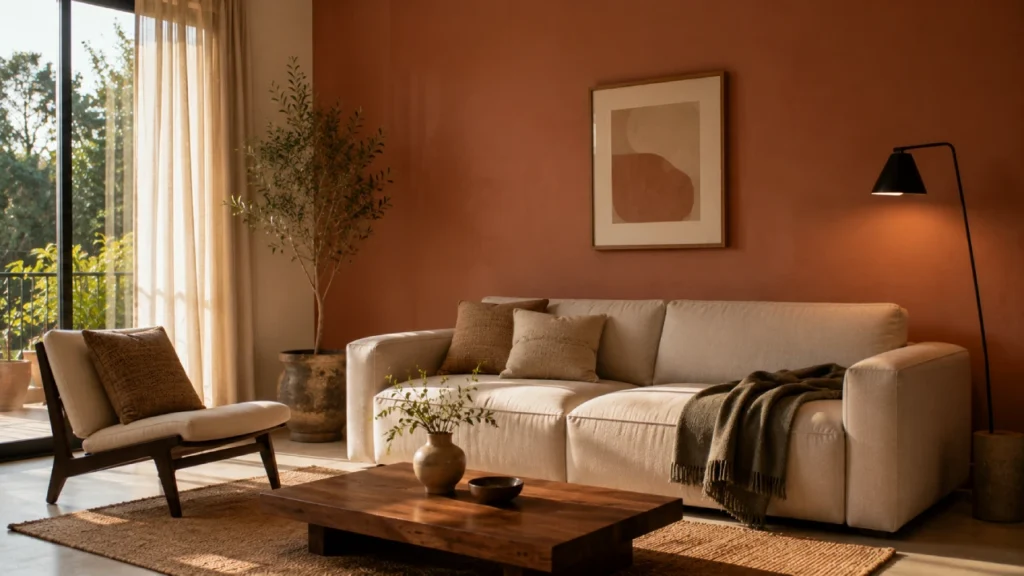
The trend connects directly with what designers are calling dopamine décor; here, interiors designed to respond to mood, energy and real life. The emotional logic is straightforward. After years of living in spaces calibrated to look good in photographs, a significant number of people have decided that their homes should feel good tactually to inhabit. Color psychology plays a meaningful role here. For example,
- Deep terracotta reads as grounding.
- Dusty sage as restorative.
- Chocolate brown as enveloping.
The palette NCS Color frames for 2026 represents a shift from neutral-dominant years toward a broader chromatic spectrum, with mid-tones returning alongside high-chromatic colors (especially reds and blues), organized into four mood directions:
- Quietude
- Homecoming
- Symbiosis
- Renegade
A closely related technique, color capping, offers a more graduated version of the same idea by using two or three shades from the same color family on walls, trim, and ceiling respectively to create layered depth without committing to a single saturated hue throughout. Both approaches share the same underlying philosophy: color is not decoration applied to a room but atmosphere built into it.
Lighting as Emotional Architecture
If color is the boldest tool in 2026’s expressive interior vocabulary, lighting is the most consequential. The shift from functional illumination to emotional lighting design is one of the defining transitions of this design moment, and it changes the character of a space more dramatically than almost any other single intervention.
Lighting in 2026 moves beyond function to become a central emotional device. It is designed to be experienced as much as it is seen. Sculptural pendants, expressive floor lamps and art-like wall lights anchor rooms with confidence, favoring bold forms, tactile materials and a sense of movement. Lighting is layered to create atmosphere, intimacy and depth.
The practical implication is a significant rethinking of how rooms are lit at different times of day. Good lighting in 2026 shapes how we inhabit a space throughout the day by softening edges, highlighting texture and allowing rooms to transition seamlessly from morning clarity to evening warmth. In color-drenched rooms specifically, lighting becomes essential structural support; picture lights, shaded sconces, warm pools, and layered lamps prevent the room from feeling visually compressed, while drawing the eye to the texture and depth of the surfaces themselves.
The fixtures driving this shift are notably sculptural, with oversized rattan pendants, vintage-style sconces with amber glass, and articulated floor lamps in aged brass or matte black. The combination of mixed metals and oversized lighting, with brass, pewter,r and statement pieces working together, infuses interiors with curated flair. The era of the recessed ceiling downlight as the primary light source for a living room is not over, but it is no longer sufficient on its own.
Fabrics, Texture, and the Return of Tactile Surfaces
The third pillar of the expressive interior shift is material richness. One of minimalism’s less-discussed costs was the flattening of tactile experience; smooth surfaces, uniform finishes, hard materials looked clean and read well on screen, but offered little to the hand or the body. The current correction is deliberately sensory.

Homes in 2026 feel more layered, tactile and intentionally personal with rich textures, velvet, wool and leather working alongside vintage floor lamps, gleaming brass and mid-century silhouettes to add soul to the corners of a room. Velvet has staged a particularly notable return on sofas, accent chairs, and cushions; its depth of color and light-catching surface quality give rooms a richness that no performance fabric can replicate. Boucle and bouclé-adjacent textures (looped, nubby, irregular weaves) continue their multi-year run as the go-to upholstery material for seating that reads as warm rather than corporate.
The acoustic interior is also emerging as a design category in its own right, with fabric-wrapped walls, slatted wood baffles, layered rugs and dual-layer drapes gaining popularity, particularly in urban apartments where noise management directly affects quality of life. The functional and the aesthetic converge neatly here; the same materials that absorb sound also happen to be the ones that make a room feel most considered and inhabitable.
For the Indian context, this shift toward material richness has a particularly resonant local dimension. A renewed respect for Indian artistry is emerging with hand-block printed upholstery, Dhokra-inspired metal artifacts, locally designed terrazzo flooring, and wall hangings in hand-woven fabrics and throws. These could be:
- A bedside lamp made by a Moradabad artisan
- A Rajasthani kantha throw layered over a deep-toned velvet sofa
- A hand-thrown ceramic vase on a mango wood shelf
These choices carry the specificity and irreproducibility that defines the expressive interior impulse at its most considered.
Storytelling Spaces: Intentional Maximalism Over Clutter
It is worth being precise about what the shift away from minimalism is not. The layered-to-the-point-of-incoherence approach where surfaces competed for attention and no single element could breathe. Modern maximalism in 2026 focuses on intentional storytelling, pairing bold patterns and tones with curated collections of art and vintage finds, unified through a common color or theme to create spaces that feel personal, sophisticated and artfully designed.
The operative word is intentional. The most articulate vision for 2026 interiors describes spaces that feel deeply personal, where rooms are shaped by patina, provenance and a quiet sense of permanence, with soulful materials, handcrafted details and layered silhouettes that invite you to exhale. It is less about maximalism or minimalism and more about an honesty of form.
Designer Franky Rousell describes the 2026 mood as being about atmosphere and layering, with curved joinery, bespoke shelving and thoughtful partitions adding interest without overwhelming, while materials with texture and depth make rooms feel grounded and approachable. Color palettes are being chosen based on the desired mood of the room.

This is the clearest formulation of what has changed. The design decision-making process has reoriented from outward to inward. Minimalism was organized around a set of rules whose ultimate arbiter was the photograph, the curated image that communicated taste to an external audience.
What to Watch Next
The trajectory of interior design in the second half of 2026 is moving further into individuality. Whether you love cozy layered spaces, bold color palettes, vintage-inspired décor, or homes filled with character, the overriding direction is toward creating spaces that feel uniquely yours, and smaller, targeted updates are proving as effective as full renovations in achieving that shift.
For those navigating this shift in practice, the most useful framing may be the simplest one. Start with the room that matters most to you, identify what emotional quality you want it to have, and build the material and color choices around that intention. A home designed from the inside out (one room at a time, one considered choice at a time) is both the aesthetic ideal and the entirely achievable reality of expressive interior design in 2026.