
Keeping in mind several parameters of the schedule of a contemporary day in life, it is safe to presume that most individuals fall somewhere in between busy, on a good day and hectic, on most days. Managing your living space then becomes one of those insurmountable chores. To solve this issue, one may implement some simple home organization ideas, tips and tricks to transform managing a living space into not just temporarily doable but highly practical.
A misconception regarding organization is that it either ends up being costly or taking up a lot of time to first implement and then maintain. That is not necessarily true since just some simple hacks can ease the day-to-day burden to managing a familial household.
home organization ideas: Give Every Item Their Own Space
One of the easiest implementations one can make to keep their home organized is to fix a place for every single item. This makes it so much simpler to find the item when required as well as check whether it is about to run out right before making grocery or shopping lists.
For example, keys can be kept in a repurposed bowl near the entrance, bags can be suspended from a specific hook and shoes can be neatly arranged inside a rack rather than kept in a pile on the floor.

When every member of the household knows the designated place of every item, less time is wasted searching for them. Moreover, cleaning and tidying up is much easier since items can be quickly returned to their designated places.
Store In Labelled Baskets and Storage Boxes and Containers
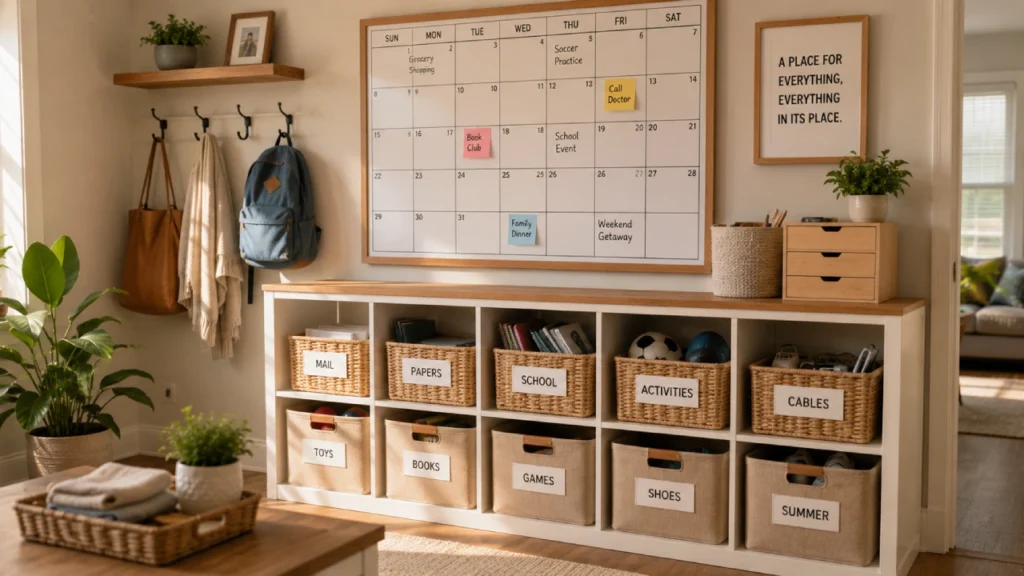
Storage boxes, baskets and other forms of containers can make a huge difference in the organization of a space. They can be utilized to group similar things together and kept labelled in a designated space. This will make it simpler for family members to know what the boxes contain without having to rummage through its contents. Boxes may be designated for toys, books, electronic accessories such as chargers, cords and headphones, cleaning products, coloring and art supplies, etc.
Keep Frequently Used Items Within Reach
It is crucial to segregate which items are essentials on a daily basis and need to be kept within reach versus which items are not regularly required. For example, toothbrushes, keys, pens, skincare products need to be kept nearby while gardening tools, extra tissues, utensils, suitcases, umbrellas, seasonal clothing and other excess products can be put away in the meantime until there is an immediate requirement.
Rarely used items can be stored on higher shelves or in inside cupboards. This ensures that the everyday spaces are not cluttered by surplus possession and make daily routines a lot quicker.
Organize One Area At A Time
It is really important to set realistic cleaning goals. It is advised to work on organizing a single area of the house at a time for busy families may not be able to dedicate hours cleaning and decluttering their entire home at once. This helps build momentum with the cleaning. For example, decluttering a single drawer, one shelf or a cupboard requires 15-20 minutes. Small yet consistent efforts make cleaning more manageable.
Involve All Members Of The Family
Cleaning should not be the responsibility of only one member of the house — it should be undertaken by everyone to whatever extent is possible. Division of labor among all members of the house makes the task go smoother and gets done quicker.
Even children can contribute in organizing alongside an adult member. They can be taught to put away their toys after playtime, organize their school essentials the day before and clear away books and notepads after ending their study session.
Incorporate Fun Rules In Cleaning Activities
Many individuals within a family system benefit from using fun rules such as “one in, one out” , which is removing an old item that is that is rarely used whenever a new product is bought or Marie Condo’s test that segregate items into keep and get rid of based on necessity and also whether it actually sparks some kind of joy. The entire process of segregation and donation can be made kid-friendly to teach them from an early age the basics of the skill of organization first-hand.
Use A Shared Family Calendar And Organizational To-dos
Busy families often struggle with the massive amounts of school activities, work schedules, appointments, social plans and household requirements. That is why a shared calendar is essential to ensure that everyone is aware of each other’s schedules and what all is upcoming.
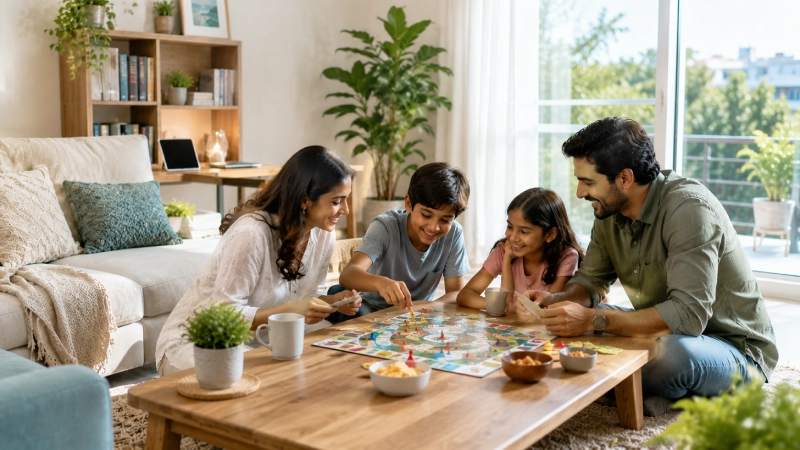
This may be in the form of whatever fits someone’s budget — a wall calendar that can be hung in a shared space, a whiteboard repurposed or a digital calendar that allows access to all for editing and inputting their own plans. This reduces some of the burden of the adults as the entire month is clearly laid out. It teaches the kids and young adults the crucial skill of managing their own time and keeping track of schedules.
Cleaning And Decluttering In Small Increments Regularly
Organizing need not refer to spending an entire weekend doing housework. Small flexible habits of cleaning one or two small manageable spaces can prevent build up. For example, putting away laundry after it’s dry into cupboards can hugely benefit from an extra step where one goes through one shelf of clothing to decide whether anything must be discarded. Other examples may be clearing kitchen counters after cooking and making excess for meal prep of the week. These small helpful habits help to reduce overall stress.
Sorting items can be done by classifying each one into one of three groups: keep, donate or discard. Avoid keeping things for the sake of using them someday and try to prioritize items that are required frequently. During the decluttering process, one may create a list of items to be replenished. Thus, several sub-tasks can be completed in the process.
Conclusion
No home is perfect, not even the best organized ones. For busy families of regular people, cleaning should be a de-stressing activity that helps to create a space that will make life easier afterwards. Simple habits such as giving every item a designated space, using storage baskets and containers, distributing the cleaning tasks and cleaning up for a few minutes each day go a long way. The goal is to develop a consistent habit of cleaning after oneself and not perfection.