
Japanese summer traditions: Summer in Japan comes with contradictions. The days can be really hot and humid, and still this season has some of the country’s more delicate things going on: you hear that wind chime, you see water scattered over warm pavement, handwritten wishes swinging from bamboo, chilled noodles eaten slow and steady, and later, nights where you watch fireworks fade into the dark. Japanese summers are also packed with lively festivals, dancing, and community celebrations. But inside all that energy, there’s a quieter appreciation for seasonality, the practice of noticing summer rather than just escaping it.
So many Japanese summer customs, even if they’re simple, feel surprisingly useful for modern wellness. Mindfulness does not have to mean a meditation app, some complicated morning routine, or an expensive retreat. Sometimes it shows up as an ordinary habit, done on purpose rather than on autopilot.
From uchimizu and fūrin to Tanabata and Obon, these traditions teach you small lessons like how to ease your pace, connect with others, and value what’s temporary, which, in summer, is basically everything.
Uchimizu: Turning Cooling Down Into a Ritual
On a hot summer day, water being scattered outside a home or a shop might look like basic cleaning. It is actually tied to uchimizu, a long-standing Japanese practice of sprinkling water over streets and outdoor spaces, kind of like a quiet habit people repeat when it’s too warm.
The tradition goes way back, at least to the Edo period. As the water evaporates, it cools the immediate area a bit, and the sight of wet pavement alone can feel soothing during Japan’s humid summers. These days, uchimizu ideas also push for using collected rainwater or reused water rather than just fresh tap water.
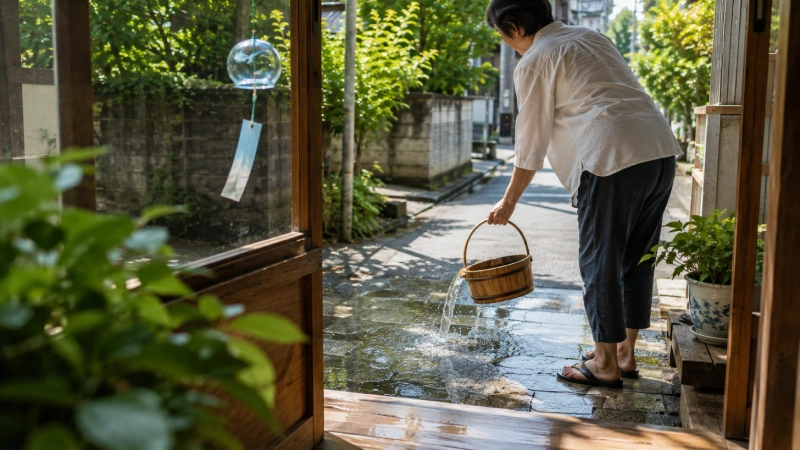
But its draw is not only temperature. There is something kind of mindful about replying to summer with a bucket of water, instead of trying to lock the season out completely. The ritual asks a person to notice the heat, step outside, and then interact with what’s around them, right there. It turns a normal, practical task into a small seasonal pause—nothing dramatic, but still real.
Fūrin: Listening to Summer
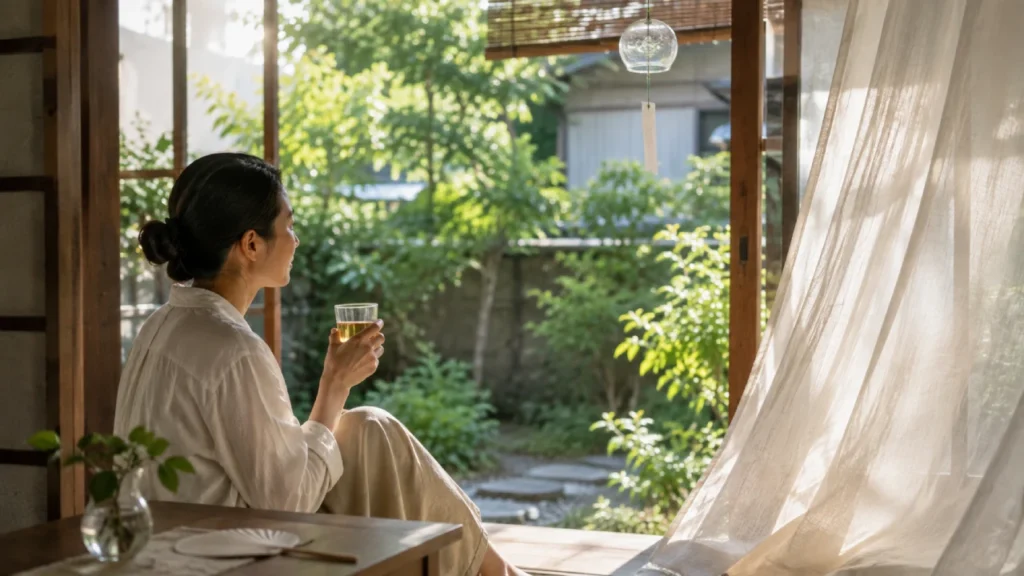
Japanese summer is often linked to fūrin, those delicate wind chimes made from glass or metal, and hung where people can actually hear them. They’re usually placed near windows, balconies, or verandas, and whenever a breeze moves through them, they make soft, light sounds.
What’s nice is how simple it feels: the breeze cannot be bossed around, and the chime can’t be rushed. A person hears it when it happens, as it arrives on its own.
In a modern home full of alarms, message tones, and notifications built to pull attention, a wind chime is almost the opposite. Its sound doesn’t demand anything; it just exists. So the tradition becomes a gentle example of sensory mindfulness, where a small sound can briefly nudge you away from the screen and back toward the weather, the room, and the present moment, even if only for a second.
Yukata: Dressing With the Season
Summer festivals across Japan are pretty much instantly associated with the yukata, a lighter, more casual cousin of the kimono, and yeah, it feels right for the season. You’ll commonly see yukata worn at matsuri and many other summer gatherings; their lightweight build is basically made for warm weather. There’s also, in a way, a broader lifestyle lesson hiding in all of it. Modern fashion often pushes the idea of clothes you can wear year-round, no matter if it’s hot or cold. Traditional seasonal dressing does something else, though: it responds to the weather, the occasion, and even the general mood.
When summer arrives, choosing breathable fabrics and silhouettes that actually feel comfortable is a small but real kind of attentiveness. It leans toward ease rather than forcing your body into unnecessary discomfort, and somehow the clothing becomes part of the season instead of fighting it.
Tanabata: Making Space for a Wish
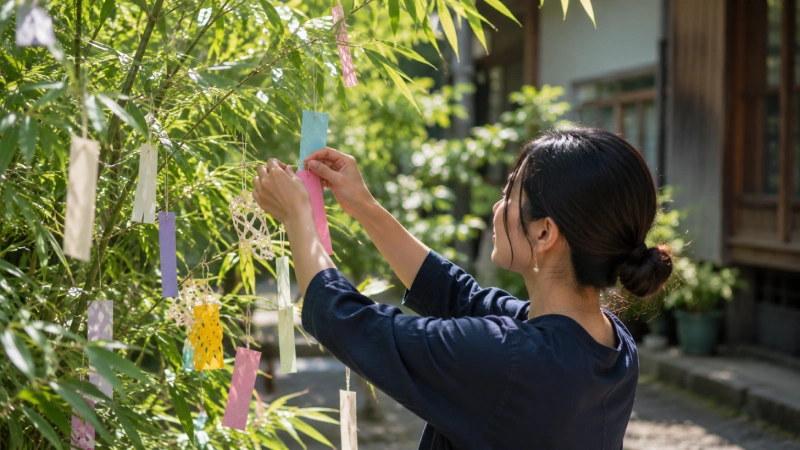
Tanabata, also known as the Star Festival, is one of Japan’s most visually delightful summer traditions. It’s inspired by the story of Orihime and Hikoboshi, shown as the stars Vega and Altair. Traditionally, it’s observed on the seventh day of the seventh month, though different regions adjust the timing. Sendai’s well-known Tanabata Festival, for example, runs from August 6 to 8 and turns the city into a kind of paper wonderland with elaborate decorations, streamers, and all that.
One custom that stands out is writing wishes on colorful strips of paper called tanzaku, then hanging them from bamboo. It’s honestly a simple act: pause, think about what matters, put it into words, and let that thought show up in the open. In a time of endless goal trackers and productivity frameworks, Tanabata feels like a softer take on intention-setting. Not every hope needs a spreadsheet or a deadline; sometimes, simply acknowledging the wish is meaningful enough.
Sōmen and Kakigōri: Eating According to the Season
Mindful living also shows up in the Japanese summer table, and it feels kinda obvious once you’re there. Cold sōmen, thin wheat noodles usually served chilled, are tightly linked with the warmer months. Kakigōri, shaved ice with flavored syrup and other toppings, is another really common summer treat. Cold noodle dishes, especially those easy to eat while they’re hot, are a refreshing answer to Japan’s heat.
Seasonal eating makes a different connection with food. Rather than assuming the same meals all year, ingredients, temperatures, and textures shift with the weather. So a bowl of cold noodles on a sticky afternoon, or shaved ice during a festival, can be unforgettable mainly because it feels like it belongs to summer, and not to the rest of the year.

Mindfulness here is almost simple, like noticing what feels right, what feels easy to the body, in that particular moment of the season.
Hanabi: Looking Up Instead of Down
Fireworks, hanabi, are a key part of the Japanese summer vibe. Big displays happen across the country, especially around July and August, and people end up outside, gathering around to watch the elaborate shows light up the night sky.
Despite all the spectacle, fireworks offer a surprisingly quiet lesson. They vanish, just like that. A firework exists for only seconds before it fades into darkness. And that beauty can’t really be saved, not in the same way as something you buy and keep at home.
Of course, phones end up appearing at most modern fireworks too. Still, the experience nudges something that daily digital life often misses: looking upward, waiting a bit, and sharing attention with hundreds, or thousands, of other people at once.
Some beautiful things are precious because they don’t last.
Obon: Slowing down to remember
Summer in Japan is also the season when you slow down and then remember. Obon, usually held around mid-August in many places, is a festival honoring deceased ancestors. It becomes an important time for family reunions; so many people go back to their hometowns, and it just feels different. Traditions vary by region and may include offerings, lanterns, grave visits, and even Bon Odori dancing.
Obon brings mindfulness into a more emotional place, one that sits a bit deeper than usual, almost like it needs a moment to arrive.
In everyday life, everything can get pulled forward: the next deadline, the next purchase, the next achievement, or the next destination. But a tradition centered on remembering earlier generations, for a while, it flips that attention.
Families return home. Communities gather, and memories plus old customs get carried forward, without you really trying.
It gently reminds people that slowing down can also mean remembering where you come from, what shaped you, and who was there before.
Bon Odori: Wellness Through Community
Mindfulness is often sold like it’s something you do alone, but Japanese summer traditions show you that being present can be shared too.
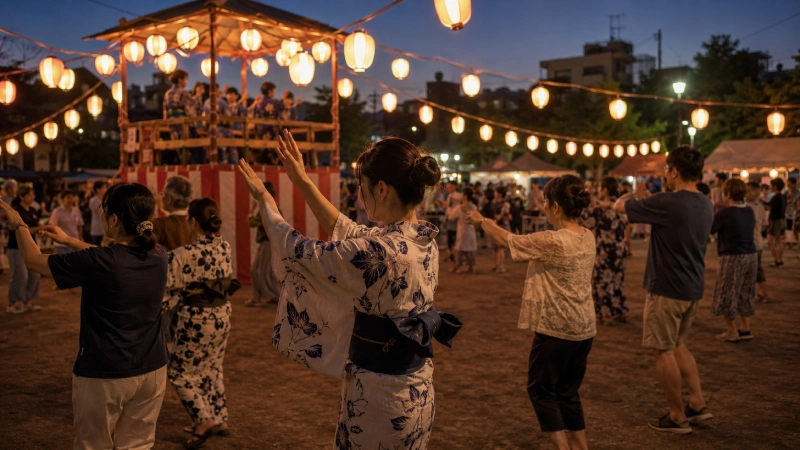
During Obon celebrations, Bon Odori pulls communities together through traditional dancing. Some events are open to people who already know the study, as well as to complete beginners, so everyone can just follow the movements of the people around them. It’s reassuring.
At Gujo Odori, for example, the summer dances run across about 30 nights between July and September, and the festival peaks during Obon. The tradition was historically meant to bring people together, even across social ranks.
Dancing to music among neighbors and strangers creates a sense of well-being that, honestly, cannot be fully replicated by individual routines alone. It blends movement, culture, a sense of belonging, and this steady joy that spreads out over time.
Summer Matsuri: Returning to Local Life
Japan’s matsuri, or festivals, somehow turn summer evenings into this warm rush with lanterns, food stalls, music, traditional clothing, dancing, and local rituals. A lot of these festivals are tied to particular communities, and their past lives too, even if people only notice it in passing. Also, some setups for certain matsuri start months in advance, so it feels like the town is quietly preparing in the background.
Their lasting charm says something about modern well-being, not in a pushy way, but as a subtle reminder.
A satisfying lifestyle isn’t made only indoors, with skincare steps, healthy meals, or super tidy, perfectly arranged spaces. Community matters, and maybe even more than people admit.
Walking through a neighborhood festival, grabbing something hot from a local stall, hearing old-style instruments, and seeing familiar faces… that whole mix makes you feel like you belong to a place. It is simple, but it has weight. Japanese summer culture also suggests that wellness can be shared without turning into a complicated system.
What Japanese Summer Can Teach Modern Life
The most interesting part of these traditions is that very few of them were invented as modern “wellness habits.” They came from religion, the climate, community ties, history, food traditions, and plain everyday necessity.
Still, when you look at them together, they show that wellness culture is being rediscovered.
Uchimizu invites engagement with the environment. Fūrin makes the breeze something you can actually notice. Tanabata opens a room for thinking slowly. Seasonal foods also draw attention to the appetite. Obon honors memory and family, while Bon Odori and matsuri naturally build community.
None of it asks ordinary life to become extraordinary every single day. Instead, they make the everyday worth seeing again.
Conclusion: Mindfulness Hiding Inside Plain Summer Moments
The charm of many Japanese summer customs is that they do not really need summer to feel comfortable first, before they can also feel meaningful. Heat, evening breezes, insects, food, flowers, water, and even short-lived fireworks all become part of how you experience the season, not just background stuff to push aside.
A furin turns wind into sound, almost like a small reminder. Uchimizu turns cooling into something intentional, not merely an accident. Seasonal dishes turn a meal into a time-marker. Matsuri reconnects the neighbors, while Obon ties today back to memory. Fireflies and morning glories reward the simple habit of watching closely and not rushing away.
Taken together, these customs point toward a kind of mindful living that is less about escaping everyday life and more about paying attention to it. In a world built to keep your focus sliding constantly toward the next message, video, purchase, or task, that lesson seems especially helpful.
Maybe a more mindful summer doesn’t require any extra effort at all. Maybe it starts with noticing the season already happening around us, right now.